


Bridges, not barriers: Rethinking India-Myanmar border management
In 2018, India and Myanmar signed an agreement on land border crossing with the aim to facilitate regulation and harmonisation of already existing free movement rights.

 "Ishan Bakshi")
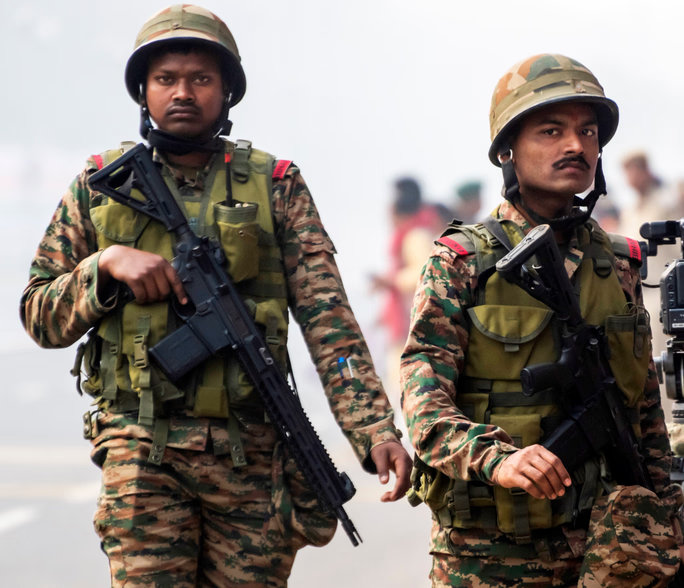 "Indian Army")
The Abhed bullet-resistant jacket has been designed by researchers at IIT Delhi (Photo: Shutterstock)
The security of the borders of India with Myanmar is increasingly coming into focus because of widespread violence and continuing ethnic conflict in Manipur. It is being said that militants and illegal entrants from Myanmar are fuelling the ongoing conflict in Manipur. It is therefore important to analyse the challenges faced in guarding the 1,643 kilometres (km)-long border that India shares with Myanmar. Four north-eastern states — Arunachal Pradesh, Nagaland, Manipur and Mizoram — share a border with Myanmar. Myanmar is also the only Asean country adjoining India and, therefore, a gateway to South East Asia.
India is seeking to enhance its cooperation with Myanmar in line with our ‘Act East’ and ‘Neighbourhood First’ policies. The border passes through difficult hilly terrain, ranging from high-altitude areas in the northern Arunachal to thickly wooded jungle along Nagaland, Manipur and Mizoram. The terrain through the border passes, besides being difficult, is ecologically fragile.
The British, while culling out a separate Burmese (Myanmar) territory on April 1, 1937, created a border which divided communities on both sides of the border. The newly created border, however, was no impediment for local tribes to retain their age-old ethnic ties. Marriages and the exchange of local goods between the villages located within the vicinity of the border continued unhampered. Many of the villages straddle the International Boundary, even though it is demarcated on the ground. One typical example is the Longwa village in Nagaland’s Mon district that uniquely straddles the India-Myanmar border, with the international boundary passing directly through the village chief’s house.
The border with Myanmar continues to be open and porous. Assam Rifles (AR) was assigned the responsibility for guarding these borders on the recommendation of the group of Ministers set up after the Kargil war. However, the ratio of troops of the AR available for border guarding is extremely low. Only 20 units out of 46 are available for guarding 1,643 kilometres (km) of border, i.e. each unit is responsible for about 65 km of border. Keeping in view the difficulty of terrain and remoteness, this is entirely inadequate.
The AR therefore needs an additional 30 to 40 units more in order to enhance the effectiveness of border guarding to the level at which the border with Bangladesh and Pakistan is guarded

 "GRSE-made passenger-cum-cargo ship")
Fostering the frontiers
The border with Myanmar is not guarded in the manner in which borders with other countries are guarded. The AR units and subunits are not located in the vicinity of the border. Being a force responsible for counterinsurgency operations in the North East, the AR operates from the company operation bases (COBs) located far away from the border, even in a border guarding role. Their system of patrolling the border is information-based, unlike the one adopted along other borders, where troops are deployed on the Border Out Posts (BOPs) located in close vicinity of the border for continuous domination.
In the absence of forward deployment of troops, it is difficult to keep the population located close to the border under constant surveillance. While terrain may make it difficult to create platoon-level BOPs in the close vicinity, it is necessary to move the COBs closer to the border in areas with comparatively large population concentration.
This will ensure better reaction ability for the troops of AR. Another fact is that there is no barrier along this border. The “Free Movement Regime” (FMR), permitting movement of locals across the border, adds to the porosity. This facilitates further strengthening of historical, linguistic and ethnic ties between the two countries.
The Indian government is working on a plan to fence the India–Myanmar border, especially in view of continuing ethnic conflict in Manipur. It is beyond doubt that the security of the nation is paramount and cannot be compromised under any circumstances. However, claims of strife in Manipur being fuelled from outside appear overhyped. Therefore, converting the border into a hard border with militaristic infrastructure is an overreaction. The move to fence this border raises several important questions. These include the experience of India with the fence along the India–Pakistan and India–Bangladesh border. While the fence along the border with Pakistan has proved effective, the same cannot be said about the fence along the Bangladesh border, where too the demographic composition, close ethnic, cultural and family ties of the population on both sides of the border are similar to that along the border with Myanmar.
While some hostile elements mixed with refugees due to internal strife in Myanmar, infiltrating cannot be ruled out, the apprehensions of them being a major cause of strife in Manipur do not stand scrutiny. The border along the other three states — Arunachal Pradesh, Nagaland and Mizoram — is equally open, and people in these states have equally strong ethnic linkages across the border.
However, these states have not witnessed any violence. Mizoram Chief Minister Lalduhoma has taken strong exception to the plan to fence the border in Mizoram, besides the plan to abandon FMR. The deputy chief minister of Nagaland has also opposed the plan to fence the border. Any attempts to fence these borders are therefore likely to meet with heavy resistance both in Nagaland and Mizoram. Even in Manipur, the tribes living in hill areas close to the border are likely to resist the move stoutly as they had done with earlier abandoned attempts to fence the border near Moreh town after construction of a couple of kms in 2004.
The construction of the fence through hilly and jungle terrain will also face heavy logistical difficulties, besides being time-consuming. Even if the planning for the fence starts immediately, it will take at least a couple of decades to complete the entire process. Additionally, for the fence to be an effective barrier, it will need 24x7 surveillance and deployment of troops close to it. Additional troops, BOPs and roads to maintain them will also be needed.
The move to fence this border will also have an adverse impact on relations with Myanmar. When the plan is actually implemented, the only unfenced Indian border will be with Nepal and Bhutan, which incidentally also permit free movement of citizens across the border. The second aspect of border management along the Myanmar border is the FMR. Several tribes live on both sides of the border and continue to have close economic, family and marital ties.
Safegarding and simplifying
These informal arrangements were thus regularised by the introduction of FMR to ease the problems of local tribes created by the division in 1937. FMR aimed to safeguard the interests and welfare of local tribes residing on both sides of the border. The FMR therefore gave impetus to local trade and business by simplifying the movement of local tribals across the border by doing away with the formalities of documentation and related financial burden upon them to obtain those documents.
According to the report of Ministry of Home affairs for 1950–51, since the members of Indian hill tribes entering Burma by land, who do not proceed beyond 25 miles from the land border, are exempted from the provisions of the Burma Passport Rules, similar exemption has been granted to members of hill tribes entering India by land, in order to remove the difficulty of members of Indian and Burmese hill tribes living in the territories adjacent to the Indo-Burmese land frontier, who habitually travel between these countries.
Initially, FMR provided that residents of Myanmar could stay in India for 72 hours, whereas the residents of India were permitted to stay in Myanmar for 24 hours. Provisions of FMR were tightened by the Indian government in 1968 after the rise of insurgency in Nagaland, Manipur and Mizoram and a permit system was introduced. In 2004, the number of crossing points was reduced to only three — Pangasu in Arunachal, Moreh in Manipur and Zokhawthar in Mizoram — from earlier multiple entry points. The distance from the border to which they could go was also reduced to 16 km. However, these restrictions were not implementable because the border being open, people could cross from anywhere.
In 2018, India and Myanmar signed an agreement on land border crossing with the aim to facilitate regulation and harmonisation of already existing free movement rights. It also included the movement of people travelling on valid documents.
The restrictions imposed on international travel since 2020 due to COVID made FMR more or less defunct from authorised crossing points. However, this had no impact on movement from open borders. The Manipur government had suspended FMR because of the influx of undocumented refugees in September 2022. The Indian government also announced the suspension of FMR in 2024 after the conflict in Manipur broke out.
Enforcing a complete stoppage of FMR is extremely difficult because of several factors. Firstly, every point on the unmanned border is a crossing point, and it is extremely difficult to supervise these unregistered crossings because the villages are located very close to the border, with some of them straddling the border. Secondly, as discussed above, borders are not under constant surveillance. The forward posture to dominate the border is not possible even in the midterm future because of terrain and logistical difficulties in establishing and maintaining BOPs.
A balancing act
An important factor to consider is that the end of the FMR will deprive people from both sides to dispose of their local produce, which is mostly perishable. The existing road and transport infrastructure makes it further difficult for them to bring their produce to the interior, which will perish and will remain of no use by the time it reaches there.
Enforcement of the termination of FMR will thus cause alienation amongst our people living close to the border unless alternate markets and means of sustenance are made available in these remote areas.
Converting these soft borders into hard ones by measures like fencing and suspending FMR, therefore, is not advisable. It is recommended that not only FMR should be retained, but the government should also consider further expanding the network of “border haats” as agreed upon in the memorandum of understanding signed between the representatives of the two countries on May 28, 2012. Some of these are already successfully functioning at few places along the Myanmar border. Such “border haats” have also proved very beneficial along the India–Bangladesh border. These haats help locals in early disposal of their produce, and facilitate transactions in either of the currencies and even barter.
By expanding “border haats” and their frequency, the necessity and dependence of border residents on FMR will gradually reduce, thus facilitating better regulation of the movement of personnel across the border. An added advantage is that this will facilitate the development of a wider area closer to the border without affecting the fragile ecology, flora and fauna of the area. This will go a long way in integrating the border residents with the mainstream.
The effectiveness of border management efforts must keep the border population in focus without compromising security. India, therefore, must follow the international trend of turning borders into bridges instead of barriers, both for better relations with Myanmar and also to ensure the welfare of the population living in remote border areas.
Written By

 "Ishan Bakshi")
First Published: Mar 11 2026 | 11:00 AM IST
In this article :