


Future date India needs to win the war of minds before the first shot
Information warfare is where legitimacy is established, deterrence is built, and sovereignty is defended
 "Indian Army")
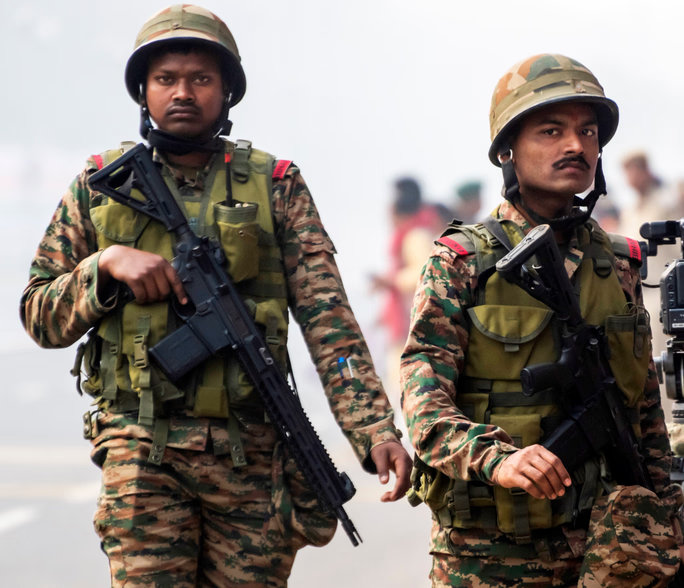
The Abhed bullet-resistant jacket has been designed by researchers at IIT Delhi (Photo: Shutterstock)
Militaries in recent decades have seen a quantum jump in the way they equip, train and organise for war. The prime drivers have been the fielding of cutting-edge technologies for war. New ideas and technologies usher in new dynamics, necessitating changes in doctrines, structures and practices. But then, shedding old ideas and practices is a challenge, as militaries tend to hedge against unintended consequences of change. The issue gets even more complicated, when change is seen in context of the past ways of prosecuting war.
Quite predictably, the Chinese military have done well to surmount this predicament. They have been successful in ushering a profound military change, and at a massive scale. The impetus has largely been political, and then technological, where the President, himself has been setting the agenda for change. In that sense, the role of the paramount leader to forge linkages between the political and strategic imperatives for institutionalising change have been the key driver of PLA reforms. The CCP’s reformation of its military force needs to be studied in this context.
A key feature of the PLA reforms has been the resoluteness of its reforms, even if they were occasionally hampered by bureaucratic stasis, or internal corruption. Open-source evidence suggests that the PLA is well past its reform objectives to assert itself at regional hotspots, including against India; if not fully beyond its reach, in the global context.
This article examines the impetus for change; the scale and scope of reforms; what particular advantage they accord to the PLA land force; and how it impact India’s military posture along the Himalayas.
First, the impact of PLA’s reforms – in terms of the theatre-isation and brigade-isation of its land force along the Himalayas - is significant. It reflects a shift towards a more integrated approach to border security, with a focus on rapid response, joint operations and precision strikes. The Western Theatre Command (WTC) caters precisely to these requirements, by enabling the PLA to improve its operational posture and responsiveness, with better infrastructure, logistics and firepower. Consequently, this increases the risk of escalation to India. On the other hand, the Indian forces are yet to theatre-ise and brigade-ise, in numbers and weaponry, to credibly contest the PLA.
Second, a brigade-ised, modular land force adds to China’s coercive posture. With a marked reduction in its infantry and mechanised divisions, and a corresponding increase in its re-organised combined arms brigades, duly supported by a commensurate compliment of artillery, air defence, engineers, SOF etc., makes the PLA, the most lethal land force in Asia. In its new avatar, the PLA modular brigades can dart down to any of its 14 land borders with greater mobility, to deliver effects in a crisis situation.
And third, it is the impressive growth of PLA’s Army aviation and Special Forces. While the aviation brigades are yet to grow to full strength, their sheer numbers indicate a formidable heli-borne capability in the future. As this capability grows in mass and quality, the PLA could pose a serious challenge to the Indian ground forces along the northern borders. Correspondingly, the PLA is also deeply invested into the creation of its special operations force. The SOF brigades are now assigned to each of combined corps. They have also been assigned to the Tibetan and Xinjiang Military Districts, highlighting the importance the PLA accords to the contested borders with India.
First Published: Feb 26 2026 | 3:20 PM IST
In this article :